

Exploring the Science Behind Different Eye Colors: The Tyndall Effect
Updated: Oct 30, 2024
Eye colors depend on how much pigment resides in the iris - the eye structure that surrounds the pupil and often is called the colored part of the eye. There is only one pigment that determines eye color: it's called melanin. The eye color also depends upon how light is absorbed and reflected by this pigment.

Everyone, regardless of their eye color, has the same type of melanin pigment. Melanin is a natural skin color produced by cells known as melanocytes. Melanocytes are found in hair, skin, and the iris of your eyes.
Everyone has the same number of melanocytes. However, they produce different amounts of melanin. This is what causes different eye colors.
What is the Tyndall effect?
The Tyndall effect is a phenomenon where light is scattered by particles in a colloid or fine suspension. It’s responsible for the blue color of the sky and can also affect the color of eyes, particularly in people with lighter irises.
What causes the Tyndall effect in an eye?
The Tyndall effect occurs when light scatters through a translucent layer of turbid media in the iris, which contains many small particles that are about 0.6 micrometers in diameter. These particles are suspended in the fibro vascular structure of the stroma, or front layer of the iris.
Brown Eye Color
Sufficient amounts of melanin will make your iris brown. Brown eyes are the result of higher melanin concentrations which absorbs more of the light, reducing the amount of light being reflected. In humans, brown eyes result from a relatively high concentration of melanin in the stroma of the iris, which causes light of both shorter and longer wavelengths to be absorbed.
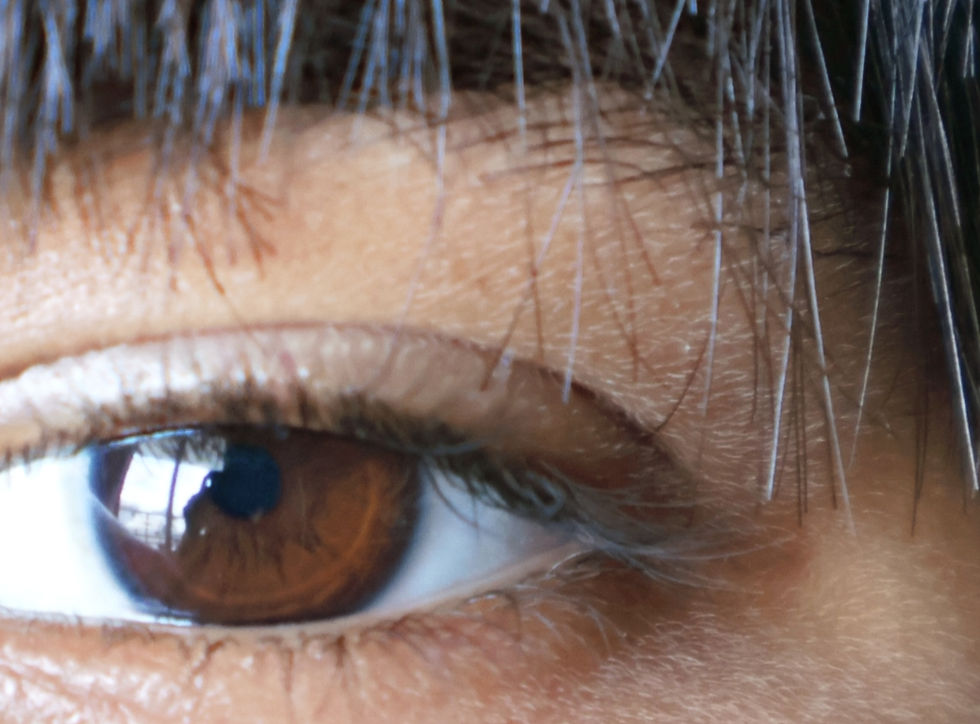
According to scientists, everyone used to have brown eyes. However, an unusual mutation (the changing of the structure of the gene) occurred about 10,000 years ago that turned off the pigmentation on the outer part of the iris. The OCA2 gene, located on chromosome 15, appears to play a major role in controlling the brown/blue color spectrum. OCA2 produces a protein called P-protein that is involved in the formation and processing of melanin.
The stroma (the tissue of the iris) contains fine collagen fibers. In lighter eyes, the reduced amount of melanin in the iris allows light to pass through and gets scattered by collagen fibers deeper in the iris. When light enters the eye, these fibers scatter short-wavelength light (blue and green) more than longer-wavelength light. it gives the eyes a lighter shade of color. When the light is reflected back, resulting in a lighter shade of color in iris and the Tyndall Effect (similar to Rayleigh scattering, which causes the sky to seem blue).

Blue eye color
Blue eye color is the result of pigment in low concentration and Rayleigh scattering (or Tyndall effect) of the short light wavelengths (blue is short, red is long).
There is no blue pigmentation either in the iris or in the ocular fluid. Dissection reveals that the iris pigment epithelium is brownish black due to the presence of melanin. Unlike brown eyes, blue eyes have low concentrations of melanin in the stroma of the iris. Longer wavelengths of light tend to be absorbed by the dark underlying epithelium, while shorter wavelengths are reflected and undergo Rayleigh scattering in the turbid medium of the stroma. Hence, making the iris appear blue due to Tyndall effect.
Green eye color
Green eyes appear to be mid-ground between blue and brown, they have more pigment than blue but less than brown.
Its appearance is caused by the combination of a light brown pigmentation of the stroma, given by a low or moderate concentration of melanin, along with the blue tone imparted by the Rayleigh scattering of the reflected light.


So, the Tyndall effect helps explain why eyes with less melanin can appear blue or green due to the way light is scattered by the structure of the iris.
Sources:


Comments